Have you ever had a teacher or coach ever tell you that "There is no I in Team". If anything I have come to learn of even greater importance of collaboration.
Sometimes I think I know everything, but turns out most of the time I don't. It is not until I start to talk with other people and learn from them do I really start to grow and sustain more knowledge.
The whole meaning of collaborating is working together, bringing knowledge from all persons to create and ever better outcome.
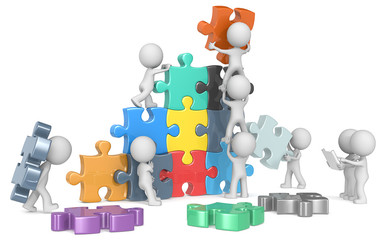
In essence we all come together with a different piece of the puzzle. We may know what the picture may be from our one piece and we may even understand exactly where our piece goes: but it is not until be bring all our pieces together that we know what the picture is or building something amazing.
This can be related to teaching and how we work with other professionals to help those students with greater needs. As we put forward out best efforts and contribute we can accomplish so much. As we all know the part we play, work things out together, and have mutual respect, the students we help will be able to flourish and progress in their education.
Granted, there will be opposition when collaborating: no one thinks exactly the same. but this gives us a chance to better develop our problem solving skills together. No ones thinking is more right than someones else's, but it is our job to communicate and problem solve to come up with the best solution to ensure the best education all students have a right to.
When I think of a collaborative effort the first thing I think about is my husband and I and the 1 marriage that we share. We both come from different back groups, families, and even cultures. but despite the differences we have 1 marriage and that makes us a team. Collaboration in Marriage is extremely important: without it you can not progress or gain happiness. If one of us quits, then the other one suffers, but on the other hand if one succeeds then we both succeed. The same can be easily said about collaborating as educational professionals. As we ALL work together there are incredible outcomes and growth both for us an individuals and those individuals which we are stiving to help succeed. Its a win-win!
Thursday, May 26, 2016
Friday, May 20, 2016
Week four and five: Importance of the law
If anything these last two weeks has really taught me the importance of law in education and how vital it is that teacher and parents know the laws that pertain to their children's education.
Any type of law has a purpose to protect rights and provide some type of security to the people they affect. Since the late 1950s, there have been many laws put in place to protect the rights to education for all students, yes all: red people, blue people, people with giant big toes, and long noses. Now I say that to not poke fun, but to really illustrate the point that EVERYONE has a right to education. this became practice when the Individuals with Disabilities Education Act was effected to law in 1975. With IDEA came 6 principles that would affect how schools around the nation treated and taught those students with disabilities.
1. IEP- Individualized Education Plan
2. Due Process- right to have case heard
3.Least Restrictive Environment (LRE)
4. Free and Appropriate Public Education (FAPE)
5. Zero reject/child find
6. Non-discriminatory Evaluation
With these principles, it has become clearer how to go about educating children of all kinds.
Now, WHY ARE THESE PRINCIPLES OF IDEA SO IMPORTANT TO KNOW AS A PROFESSIONAL AND PARENT???????????????????????????????????????
It is important to know these in general because we will all come into some contact with children with disabilities and it is so important to know our options and know how best to help them in their situations. It could be your own child, grandchild, niece, nephew, student, or neighbor, and the best way to ensure all rights to these children is by having our own knowledge of their rights.
Second, it is important for professionals to know these principles to help advocate for their students or to know students rights when certain cases present themselves. As a professional you really want to have these down so you can make the best decisions possible for the students you serve.
The more we as a society know these laws, the greater education we can provide our future children to help them become fellow contributors to society.
Any type of law has a purpose to protect rights and provide some type of security to the people they affect. Since the late 1950s, there have been many laws put in place to protect the rights to education for all students, yes all: red people, blue people, people with giant big toes, and long noses. Now I say that to not poke fun, but to really illustrate the point that EVERYONE has a right to education. this became practice when the Individuals with Disabilities Education Act was effected to law in 1975. With IDEA came 6 principles that would affect how schools around the nation treated and taught those students with disabilities.
1. IEP- Individualized Education Plan
2. Due Process- right to have case heard
3.Least Restrictive Environment (LRE)
4. Free and Appropriate Public Education (FAPE)
5. Zero reject/child find
6. Non-discriminatory Evaluation
With these principles, it has become clearer how to go about educating children of all kinds.
Now, WHY ARE THESE PRINCIPLES OF IDEA SO IMPORTANT TO KNOW AS A PROFESSIONAL AND PARENT???????????????????????????????????????
It is important to know these in general because we will all come into some contact with children with disabilities and it is so important to know our options and know how best to help them in their situations. It could be your own child, grandchild, niece, nephew, student, or neighbor, and the best way to ensure all rights to these children is by having our own knowledge of their rights.
Second, it is important for professionals to know these principles to help advocate for their students or to know students rights when certain cases present themselves. As a professional you really want to have these down so you can make the best decisions possible for the students you serve.
The more we as a society know these laws, the greater education we can provide our future children to help them become fellow contributors to society.
Friday, May 6, 2016
Week 3: Two is better than One.
Traditionally in a classroom there is 1 teacher to about 25ish students. I remember that most of the time when I was in Elementary. Sometimes it was hard to get the attention that you needed or there were concepts not quite understood because that one teacher could not focus on just you. After this week I have learned that most of the time that is not the best scenario, but rather co-teaching is a more effective way for teacher and students to be successful.
There are 7 different models of co-teaching that teachers can pick to use bases on needs of students and resources
1. One teach, one observe: There is one teacher whose primary responsibility is to just teach while another teacher observes behaviors of children, or can see who understands and who doesn't. this is effective in many ways: the main teacher doesn't always see the same picture and then teachers can come together to talk of observation.
2. One teach one assist: while one teacher is doing the teaching, the other can help with set up or can focus on helping individual students as needed.
3. CENTERS!: groups spend time at different stations with different teachers teaching different curriculum.
4. Parallel teaching: divide students in half and teachers teach same content, just able to focus on less children at a time.
5. Supplemental: one teacher works with students at expected levels while another works with students that need more help and things to be retaught to them.
6. Alternative teaching: different teaching strategies that help teach the same content
7. Team teaching: lesson taught together, flows nice, both are actively involved in this teaching process.
These are 7 very different models of teaching from the traditional style of one teacher per classroom. I feel that these models work better for students because it allows two educators, or more, to help in the learning process. These models allow for different perspective in teaching in learning that that positive impacts on students.
If anything I learned that there is not one right or wrong way to teach, just like there is not one right or wrong way to how we learn. In order for these 7 models to work, teachers must have positive relationships with their students and know the needs of individuals. There is no right or wrong when it comes to teaching, but there are better and best options to help meet the needs of all the students you teach.
There are 7 different models of co-teaching that teachers can pick to use bases on needs of students and resources
1. One teach, one observe: There is one teacher whose primary responsibility is to just teach while another teacher observes behaviors of children, or can see who understands and who doesn't. this is effective in many ways: the main teacher doesn't always see the same picture and then teachers can come together to talk of observation.
2. One teach one assist: while one teacher is doing the teaching, the other can help with set up or can focus on helping individual students as needed.
3. CENTERS!: groups spend time at different stations with different teachers teaching different curriculum.
4. Parallel teaching: divide students in half and teachers teach same content, just able to focus on less children at a time.
5. Supplemental: one teacher works with students at expected levels while another works with students that need more help and things to be retaught to them.
6. Alternative teaching: different teaching strategies that help teach the same content
7. Team teaching: lesson taught together, flows nice, both are actively involved in this teaching process.
These are 7 very different models of teaching from the traditional style of one teacher per classroom. I feel that these models work better for students because it allows two educators, or more, to help in the learning process. These models allow for different perspective in teaching in learning that that positive impacts on students.
If anything I learned that there is not one right or wrong way to teach, just like there is not one right or wrong way to how we learn. In order for these 7 models to work, teachers must have positive relationships with their students and know the needs of individuals. There is no right or wrong when it comes to teaching, but there are better and best options to help meet the needs of all the students you teach.
Subscribe to:
Posts (Atom)

